

Table of Contents
- What Is Delayed Onset Muscle Soreness (DOMS)?
- What Are Fish Collagen Peptides?
- Clinical Research: What the Studies Show
- How Fish Collagen Peptides Work Inside Your Body?
- Fish Collagen vs. Bovine vs. Plant-Based: Key Differences
- How to Use Fish Collagen Peptides in Sports Nutrition Products?
- Why Choose Titan Biotech Limited for Fish Collagen Peptide?
- About Titan Biotech Limited
- Final Thoughts
- Frequently Asked Questions (FAQ)
- References and Clinical Study Links
What Is Delayed Onset Muscle Soreness (DOMS)?
You lifted heavy, ran hard, pushed past your limits. You were proud of yourself. Then the next morning arrived and getting out of bed felt like a punishment. Your legs ache, your arms feel like concrete, and every step down the stairs is a reminder of yesterday’s effort.
This is called Delayed Onset Muscle Soreness (DOMS) and it is one of the most common frustrations for athletes, gym-goers, and fitness enthusiasts alike. DOMS typically sets in 12 to 24 hours after intense physical activity and can last anywhere from 2 to 5 days, depending on the type of workout, your fitness level, and how well you recover.
The science behind it is straightforward: when you perform intense or unfamiliar exercise, you create tiny microscopic tears in your muscle fibers. While this damage is necessary for muscle growth and adaptation, the inflammatory response your body triggers in response is what causes that familiar stiffness, swelling, and pain.
Here is the part that most athletes miss: recovery is not just about rest and hydration. Your muscles, tendons, ligaments, and connective tissues all require specific building blocks to repair efficiently. And one of the most critical yet overlooked building blocks is collagen.
What Are Fish Collagen Peptides?
Fish collagen peptides (FCP), also called marine collagen peptides, are bioactive proteins extracted from fish skin and scales through a process called enzymatic hydrolysis. This process breaks large collagen molecules into smaller peptide chains that your body can absorb and use with remarkable speed.
Unlike many generic protein supplements, fish collagen peptides contain a unique amino acid profile rich in glycine, proline, and hydroxyproline. These are the very amino acids that form the structural backbone of muscle connective tissue, tendons, and ligaments. These are the tissues most affected by intense training, and the ones that benefit the most from targeted collagen supplementation.
Clinical Research: What the Studies Show
Fish collagen peptides are not just a wellness trend. A growing body of peer-reviewed clinical research is validating their role in post-exercise recovery.
1. Significant Reduction in Exercise-Induced Muscle Soreness
A 2023 randomized, double-blind crossover clinical trial published in the Journal of the International Society of Sports Nutrition (Kuwaba et al., 2023) specifically found that dietary collagen peptides significantly alleviated exercise-induced muscle soreness in healthy middle-aged males. Participants who consumed collagen peptides consistently reported measurable reductions in soreness compared to placebo.
2. Lower Stress Markers with Regular Supplementation
A major 12-week intervention study by Bischof et al. (2024), published in Sports Medicine and conducted at the University of Vienna, found that participants who took 15g of collagen peptides daily showed significantly lower exercise-related stress markers compared to the placebo group. The study included 75 healthy male participants in a double-blind, randomized, placebo-controlled design.
3. Improved Fat-Free Mass and Functional Recovery
A comprehensive systematic review and meta-analysis published in Sports Medicine (Bischof et al., 2024) analyzed 19 randomized controlled trials encompassing 768 participants. The results confirmed statistically significant improvements in fat-free mass (SMD 0.48, p < 0.01) and tendon morphology in groups receiving long-term collagen peptide supplementation alongside physical training. Recovery-related outcomes were also tracked across five studies within this review.
4. Fish Collagen Peptides and Skeletal Muscle Injury
A 2024 study published in the Journal of Functional Foods (Yang et al., 2024) investigated the effects of fish collagen peptide supplementation on skeletal muscle injury. The findings demonstrated that FCP supplementation helped ameliorate muscle injury markers, providing mechanistic evidence for its protective role in active muscle tissue.
How Fish Collagen Peptides Work Inside Your Body?
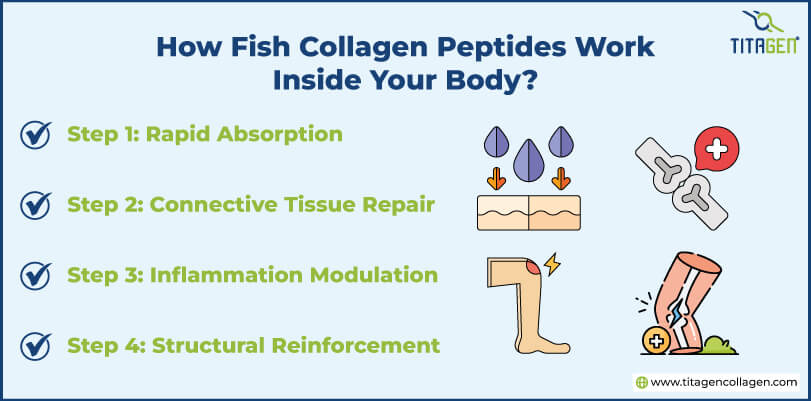
Understanding the mechanism helps explain why fish collagen peptides are so effective for recovery.
Step 1: Rapid Absorption
Fish collagen peptides have a molecular weight of just 2,000 to 3,000 Daltons, significantly smaller than bovine collagen (3,000 to 8,000 Daltons). Research shows that marine collagen can be detected in the bloodstream within 30 minutes of consumption, and is up to 1.5 times more bioavailable than other collagen sources.
Step 2: Connective Tissue Repair
Once absorbed, the peptides stimulate fibroblasts, the cells responsible for producing new collagen in muscle connective tissue (intramuscular connective tissue or IMCT). This accelerates the repair of microtears caused by intense exercise.
Step 3: Inflammation Modulation
Glycine, one of the dominant amino acids in fish collagen, plays a key role in reducing inflammatory signaling. By dampening the over-inflammatory response that causes prolonged DOMS, fish collagen peptides help you move from pain to performance faster.
Step 4: Structural Reinforcement
With consistent supplementation, collagen peptides improve the mechanical strength of tendons and ligaments, meaning fewer soft tissue injuries over time and better performance under load.
Fish Collagen vs. Bovine vs. Plant-Based: Key Differences
Not all collagen is created equal. Here is why marine-sourced fish collagen stands out, especially for active individuals:
- Superior Bioavailability: Fish collagen is absorbed up to 1.5 times more efficiently than bovine or porcine collagen, as confirmed by published research in Marine Drugs (2024).
- Almost Exclusively Type I Collagen: Type I is the most abundant collagen in the human body and is the primary structural protein in muscle connective tissue, tendons, and skin.
- Religiously Inclusive: Suitable for those who avoid beef (halal, certain Hindu dietary preferences), making it accessible to a much wider consumer base.
- Sustainable and Clean: Fish collagen is typically produced from fish by-products, skins and scales that would otherwise go to waste, making it a more sustainable and environmentally responsible protein source.
- No BSE Risk: Unlike bovine sources, fish collagen carries no risk of Bovine Spongiform Encephalopathy (mad cow disease), an important consideration for quality-conscious manufacturers.
How to Use Fish Collagen Peptides in Sports Nutrition Products?
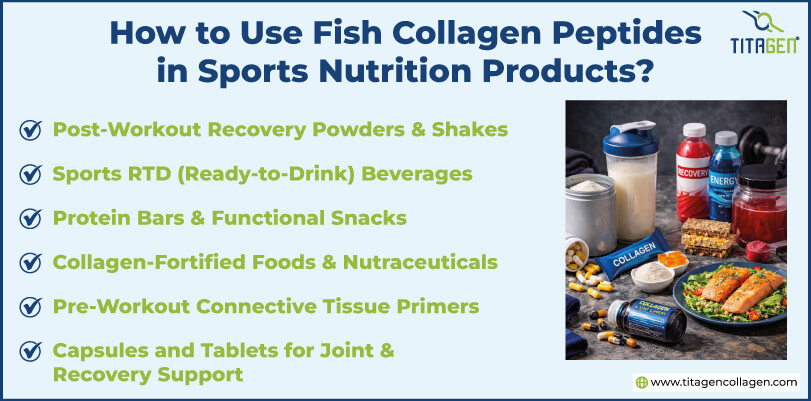
For sports nutrition brands, supplement formulators, and contract manufacturers, fish collagen peptide powder from Titan Biotech is a highly versatile raw ingredient. Here is how it is being used across the industry:
1. Post-Workout Recovery Powders and Shakes
Fish collagen peptide powder mixes cleanly into water, milk, or other protein bases. It is tasteless and odorless in high-quality grades, making it ideal for flavored recovery shakes. Pairing it with vitamin C (which enhances collagen synthesis) maximizes its effectiveness.
2. Sports RTD (Ready-to-Drink) Beverages
With its excellent solubility and neutral profile, fish collagen peptide is an ideal ingredient for ready-to-drink sports recovery beverages, energy drinks, and functional waters, a segment experiencing explosive growth globally.
3. Protein Bars and Functional Snacks
FCP can be incorporated into protein bars, energy chews, and snack formulations. It complements whey, casein, or plant proteins and adds a connective tissue recovery angle that standard protein bars lack.
4. Capsules and Tablets for Joint and Recovery Support
For brands targeting joint health and sports recovery in a convenient capsule format, fish collagen peptide powder is an excellent base. It can be combined with glucosamine, MSM, vitamin C, and magnesium for a comprehensive joint-recovery formula.
5. Collagen-Fortified Foods and Nutraceuticals
Fish collagen peptide is increasingly being added to functional foods such as yogurts, soups, and fortified cereals. For nutraceutical brands, it offers a science-backed ingredient story that resonates with health-conscious consumers.
6. Pre-Workout Connective Tissue Primers
Emerging research suggests that consuming collagen peptides with vitamin C approximately 60 minutes before exercise may prime tendons and ligaments for the mechanical load ahead, a novel application gaining traction in elite sports nutrition.
Why Choose Titan Biotech Limited for Fish Collagen Peptide?
Titan Biotech Limited is one of India’s leading manufacturers and exporters of fish collagen peptide powder. Our product is:
- Enzymatically hydrolyzed for maximum bioavailability.
- Available in multiple grades: food, nutraceutical, and cosmetic.
- Produced under strict GMP-compliant manufacturing conditions.
- Tested for heavy metals, microbial safety, and protein content.
- Available in bulk quantities for B2B buyers and OEM brand developers.
- Exported to markets across Asia, Europe, the Middle East, and North America.
Whether you are a sports nutrition brand looking for a reliable raw material supplier, or a contract manufacturer seeking a collagen ingredient with a strong clinical story, Titan Biotech has the product and the expertise to support your formulation goals.
About Titan Biotech Limited
Titan Biotech Limited is one of India’s leading manufacturers and exporters of specialty proteins, bioactive peptides, and nutraceutical ingredients, serving the pharmaceutical, nutraceutical, cosmetic, and functional food industries across global markets.
With decades of expertise in enzymatic hydrolysis and protein processing, the company operates GMP-compliant facilities with rigorous quality control across heavy metal safety, microbial integrity, and protein content verification. Titan Biotech supplies bulk ingredients to B2B buyers across Asia, Europe, the Middle East, and North America.
Titagen Collagen: The Marine Collagen Line by Titan Biotech
Titagen Collagen is Titan Biotech’s dedicated marine collagen brand, developed for the sports nutrition, joint health, and functional food sectors. Enzymatically hydrolyzed to a molecular weight of 2,000 to 3,000 Daltons, it delivers fast absorption, neutral taste and odor, and clinically supported recovery benefits, available in food, nutraceutical, and cosmetic grades with halal-certified options.
Final Thoughts
Muscle soreness is not a badge of honor if it keeps you from training consistently. The faster you recover, the more you can train, and the better your results will be over time.
Fish collagen peptides offer a scientifically supported, naturally derived solution to one of the most persistent problems in athletic performance, slow connective tissue recovery. With superior bioavailability, a unique amino acid profile, and a rapidly growing evidence base, fish collagen peptide is quickly becoming a staple ingredient in elite sports nutrition formulations worldwide.
Titan Biotech Limited is proud to be at the forefront of this movement, providing manufacturers, brands, and formulators with high-quality fish collagen peptide powder backed by science, quality control, and export-grade standards.
Frequently Asked Questions (FAQ)
Q1. How much fish collagen peptide should an athlete take daily?
Clinical studies most commonly use dosages between 10g and 15g per day. The 2024 meta-analysis by Bischof et al. found 15g per day to be the most common and well-tolerated dose. For sports recovery, 10 to 15g per day, ideally taken post-workout or before bed, is widely recommended.
Q2. How long does it take to see results from fish collagen peptides?
Most clinical studies observe measurable improvements in recovery markers and soreness reduction within 4 to 12 weeks of consistent daily supplementation. Some users report reduced post-workout soreness within the first 2 to 3 weeks.
Q3. Can fish collagen peptides be combined with whey protein?
Yes. Fish collagen peptides and whey protein have complementary amino acid profiles. Whey is rich in branched-chain amino acids (BCAAs) for muscle protein synthesis, while collagen peptides support connective tissue repair. Together, they provide a more complete recovery solution.
Q4. Is fish collagen peptide safe for daily use?
Yes. Fish collagen peptides are generally recognized as safe (GRAS) and are well-tolerated at recommended doses. They are naturally derived, minimally processed, and free from common allergens (except for those with fish allergies).
Q5. What is the difference between collagen peptides and plain collagen protein?
Regular collagen protein has a high molecular weight and is poorly absorbed by the body. Collagen peptides are hydrolyzed, meaning they have been enzymatically broken into smaller chains, which dramatically increases their bioavailability and speeds up absorption into the bloodstream.
Q6. Can fish collagen peptides help prevent sports injuries?
Emerging evidence suggests that consistent collagen peptide supplementation can improve the mechanical strength of tendons and ligaments over time, potentially reducing the risk of soft tissue injuries. The 2023 Bischof et al. study at the University of Vienna specifically tracked biomechanical recovery markers in this context.
Q7. Is Titan Biotech’s fish collagen peptide suitable for halal and kosher formulations?
Titagen Collagen by Titan Biotech Limited is derived from certified fish sources. Halal-certified grades are available. Please contact the team for specific certification documentation based on your market requirements.
Q8. What makes Titagen Collagen different from other marine collagen products?
Titagen Collagen is produced under strict GMP-compliant conditions, enzymatically hydrolyzed for maximum bioavailability, and available in food, nutraceutical, and cosmetic grades. Each batch is tested for heavy metals, microbial safety, and protein content. Titan Biotech also offers bulk B2B supply and OEM formulation support, making Titagen Collagen a reliable choice for sports nutrition brands globally.
References and Clinical Study Links
- Bischof K, et al. (2024). Impact of Collagen Peptide Supplementation in Combination with Long-Term Physical Training. Sports Medicine, 54(11), 2865-2888. PubMed
- Bischof K, et al. (2023). Influence of specific collagen peptides and 12-week concurrent training on recovery-related biomechanical characteristics. Frontiers in Nutrition, 10, 1266056. Frontiers
- Kuwaba K, et al. (2023). Dietary collagen peptides alleviate exercise-induced muscle soreness in healthy middle-aged males. Journal of the International Society of Sports Nutrition, 20, 2206392. Taylor and Francis
- Yang Y, et al. (2024). Fish collagen peptides supplementation ameliorates skeletal muscle injury. Journal of Functional Foods. ScienceDirect
- Kirmse M, et al. (2024). Collagen Peptide Supplementation and Musculoskeletal Performance: A Systematic Review and Meta-Analysis. Dtsch Z Sportmed, 75, 179-188. German Journal of Sports Medicine
- Morton et al. (2024). Effects of Collagen Peptides on Muscle Damage, Inflammation and Recovery: An Integrative Review. Nutrients, 16(19), 3403. MDPI
- Lim YS, et al. (2024). Fish By-Product Collagen Extraction Using Different Methods and Their Application. Marine Drugs, 22(2), 60. PMC
- Clifford T, et al. (2019). The effects of collagen peptides on body composition, collagen synthesis, and recovery from joint injury and exercise. Amino Acids. PMC